
The short answer
Strategy and intelligence is the work you do before a single dirham goes into media. It answers five questions: who should we win first, what do they ask and say, what do our rivals leave open, how do we enter or grow in this market, and when does demand actually peak. Brands that answer them first spend less to learn the same things later.
It matters more in 2027 than it did two years ago, for one reason: the first place people ask is changing. BrightLocal's 2026 survey found that 45% of US consumers used AI tools such as ChatGPT for local business recommendations in the past year, up from 6% a year earlier. Google use for the same job fell from 83% to 71%. When the question moves, the brand that was found yesterday can be missing today, and nobody notices until the leads thin out.
This guide covers every service inside AdTact's Strategy and Intelligence layer, with 2026 data, 2027 forecasts and a source for every number. Each service has its own section, so you can jump straight to the one you need.
Who this is for: founders, marketing heads and finance leaders in the UAE, Saudi Arabia and the wider GCC who want to decide where to invest before they invest, and want to understand what a strategy and intelligence partner should actually deliver.
14 numbers that explain why this layer comes first
-
45%
of US consumers used AI tools for local business recommendations in the past year, up from 6%.
BrightLocal 2026 -
52%
started their latest local search on Google; 8% began with AI.
BrightLocal, Jul 2026 -
75%
of local searchers used more than one channel.
BrightLocal, Jul 2026 -
−58%
top-position click-through rate when an AI Overview appears.
Ahrefs, Feb 2026 -
8% vs 15%
of visits with a result click, with and without an AI summary.
Pew Research, 2025 -
67%
of B2B buyers prefer a rep-free experience.
Gartner, Mar 2026 -
69%
still prefer to validate AI-generated insights with sales reps.
Gartner, May 2026 -
75%
of B2B purchase decisions forecast to be influenced by AI agents in 2027.
Forrester forecast -
7.8%
of revenue: the average marketing budget in 2026, up from 7.7%.
Gartner CMO Spend Survey -
25%
of marketers say they understand their audiences “very well”.
Brandwatch, Mar 2026 -
31%
of Saudi purchases involve a brand chosen in advance.
BCG, Oct 2026 -
129% vs 80%
brand value growth since 2019: more meaningful brands versus those that lost meaning.
Kantar BrandZ 2026 -
1 in 3
new launches reach 1% of households (UK, Germany, France, Italy, Spain).
NielsenIQ, Apr 2026 -
1% → 20%
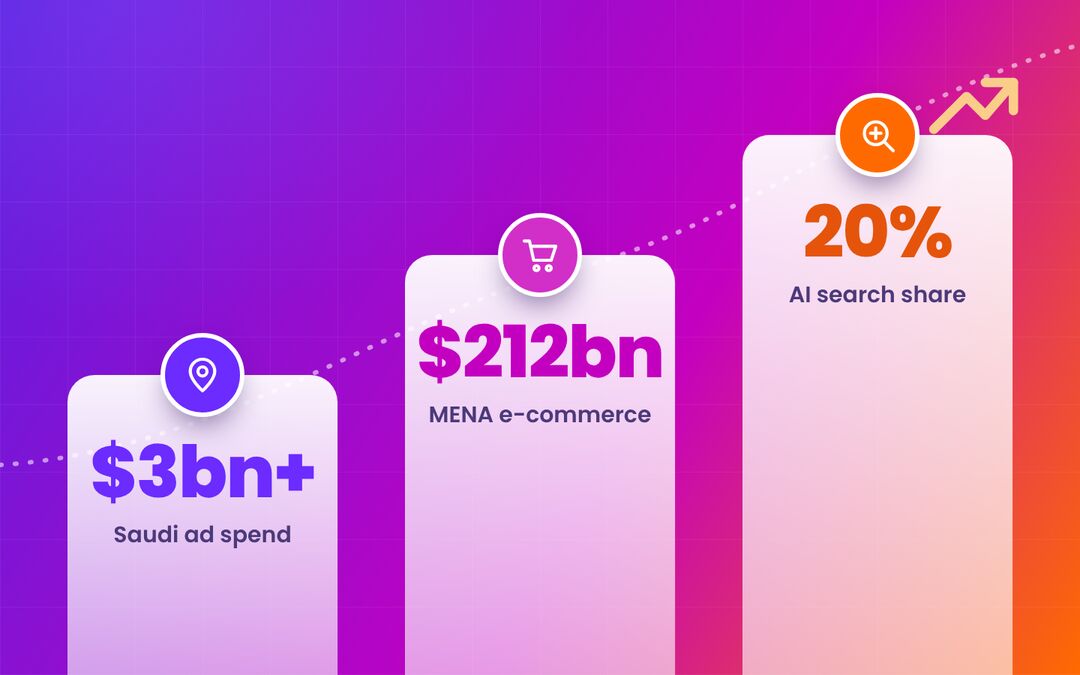
generative search’s forecast share of MENA search ad revenue, 2026 to 2031.
WPP Media
The pattern behind them: buyers research alone, across more channels, with AI as one of them, and then check what they found with a person. The brand that has done its homework on the buyer wins the checking stage too.
What is strategy and intelligence, and what is it not?
It is a short, evidence-led project that ends in decisions, not a deck that sits in a folder. Intelligence is what you learn: how people search, what they say, what rivals do, when demand rises. Strategy is what you decide with it: who to win first, what to say, which channels, in what order, with what budget.
It is not a brand mood board, a keyword list or a competitor screenshot collage. Those are inputs. The output is a single brief that marketing, sales and finance can all sign, with one business number at the top, such as bookings, qualified enquiries or revenue.
We organise the work around five questions, and the rest of this guide follows them.
| Question | What answers it | Section |
|---|---|---|
| Where do people ask, and does our brand appear? | Search and AI visibility | Search and AI visibility |
| Who are they, and what do they say and do? | Audience, consumer and competitor intelligence | Competitor, audience and consumer intelligence |
| How do we enter or grow in this market? | Go-to-market | Go-to-market |
| What do we stand for, and where do we invest? | Brand strategy and social listening | Brand strategy and social listening |
| When does demand peak? | Seasonal and campaign planning | Seasonal and campaign planning |
Why does this layer matter more in 2027?
Four shifts make the groundwork more valuable, and more expensive to skip.
1. The first question is moving to AI, but Google is not going away. The same BrightLocal programme's July 2026 study of 1,227 US consumers found that 52% started their most recent local search on Google Search and only 8% chose AI as their first channel. But 75% used more than one channel, and 31% now use AI tools for local recommendations at least monthly. The honest summary: AI is a growing second stop, and a brand has to be visible at every stop. Both studies are US data; we use them as the clearest published read on the pattern, and the GCC figures in our MENA & GCC outlook point the same way, with about 73% of the UAE's working-age population using AI in the second quarter of 2026.
Pale bar: 2025. Gradient bar: 2026. Each row is scaled to its 2026 value. Google is still the biggest source, and AI tools are now the third most popular.
Source: BrightLocal Local Consumer Review Survey 2026, 1,002 US adults, published 11 February 2026.
2. Buyers are doing the research before they talk to you. Gartner's March 2026 release reports that 67% of B2B buyers prefer a rep-free experience and 45% used AI during a recent purchase (646 buyers, August to September 2025). A May 2026 follow-up found 69% still prefer to validate AI-generated insights with sales reps, and that buyers use an average of seven information sources. The work happens before the conversation, so your intelligence has to be there first.
3. Forecasts say agents will join the buying process. Forrester's 2027 B2B predictions, published on 21 October 2026, say AI agents will influence 75% of B2B purchase decisions, that buyers will double their human interactions to validate AI recommendations, and that two-thirds of providers will lose deals because buyers cannot verify their claims. Treat these as forecasts, not facts. The direction is clear: consistent, checkable proof matters more than a clever claim.
4. Budgets are flat while expectations grow. Gartner's 2026 CMO Spend Survey found marketing budgets at 7.8% of company revenue, up only from 7.7%, with 56% of CMOs saying they lack the budget to deliver their 2026 strategy (401 leaders, North America, the UK and Europe, January to March 2026). When money is tight, deciding well matters more than doing more.
Search and AI visibility
Search and AI visibility is the work of making sure your brand appears, accurately and favourably, wherever people ask: Google, maps, and AI assistants such as ChatGPT, Gemini and Perplexity. It is the most direct way to turn intelligence into enquiries, which is why we treat it as a Signature service.
Two numbers frame the job. First, clicks are scarcer when an AI summary appears. Pew Research, studying 900 US adults in March 2025, found people clicked a traditional result in 8% of visits with an AI summary and 15% without one, and clicked a link inside the summary in just 1%. Ahrefs, comparing December 2023 with December 2025 across 300,000 keywords, found AI Overviews reduce the organic click-through rate of the top position by 58%. Second, spending on this is rising: the WPP Media forecast cited by Communicate Online in June 2026 has generative search growing from 1% of MENA's search-and-intelligence ad revenue in 2026 to 20% by 2031.
Share of visits in which the person clicked. Ahrefs’ separate study of 300,000 keywords found AI Overviews cut the top position’s click-through rate by 58%.
Sources: Pew Research Center, 900 US adults, March 2025; Ahrefs, February 2026.
SEO
SEO is making your pages easy for search engines to find, understand and rank for the questions your buyers type. In 2027 it is still the foundation: Google's own guidance for its AI features says to keep to the same basics. A good SEO plan starts from demand, not from your site: the real questions in Arabic and English, grouped by what the person wants to do, then mapped to pages that answer them fully. We prioritise by commercial value, not search volume alone.
Technical SEO
Technical SEO is the plumbing: whether search engines can crawl, render and index your pages quickly. Google's AI features documentation is explicit that there are "no additional requirements to appear in AI Overviews or AI Mode", and lists the basics worth checking: crawling allowed in robots.txt and by any CDN or hosting layer, important content available as text, internal links that make content findable, and structured data that matches the visible text. Our audit checks each of those, plus speed on a real phone.
Local SEO
Local SEO is how a business with a physical presence appears for "near me" and area searches. For a clinic, salon, restaurant or showroom it is often the highest-intent traffic available. Google says local results rely mainly on "relevance, distance, and popularity", and that "there's no way to request or pay for a better local ranking". So the work is steady and earned: complete listings, consistent details everywhere, photos, and a flow of real reviews. BrightLocal's 2026 survey shows why reviews matter: 97% of consumers read reviews for local businesses, and 41% always do (up from 29%).
Google Business Profile
Your Google Business Profile is often the first impression a local customer gets, before they see your website. Google's guidance is plain: verify the business, keep information "complete and accurate", reply to reviews, and add photos and videos, because "businesses with complete and accurate info are more likely to show up in local search results." We set up and maintain the profile, the categories, the products or services listed, and the review-reply routine, and we check that opening hours and details match every other listing. Note that star ratings now carry weight: in BrightLocal's 2026 survey, 68% of consumers said they would only use a business rated four stars or more, up from 55%.
AEO (answer engine optimisation)
AEO is structuring your content so that search features and assistants can lift a direct, correct answer from it. The method is simple and unglamorous: a question as a heading, the answer in the first one or two sentences, then the detail. Pages that open with the answer are easier for people to scan and easier for machines to quote. We build question maps from real searches and customer calls, and write or restructure pages to answer each one cleanly, with the facts a buyer needs to see: price ranges where you can share them, process, timeframes, who it is for and who it is not for.
GEO (generative engine optimisation)
GEO is getting your brand mentioned and described correctly in generative answers. The honest position, per Google, is that there is no special trick: Google states there is "no special schema.org structured data that you need to add" and that "there are no additional technical requirements" beyond being indexed and eligible to appear with a snippet. What changes behaviour is being the clearest, most consistent source on your subject, across your site, your profiles and credible third parties. A useful reference point is Kantar's 2026 BrandZ analysis, reported by Marketing Week: in skincare searches, La Roche-Posay held 11.29% of large language model responses and CeraVe 10.94%, which Kantar links to online relevance, cultural presence and clear associations with consumer needs. The lesson is that AI visibility rewards brands that are well known for something specific.
The money is following. Conductor's State of AEO/GEO report, summarised by eMarketer, found US enterprises put an average of 12% of digital marketing budgets into GEO in 2025, and 94% of the leaders surveyed planned to spend more in 2026. That is a US enterprise sample; we quote it as a direction, not a GCC benchmark.
AI visibility audits
An AI visibility audit is a structured check of what assistants say about you today. We take 30 to 50 questions that a real buyer in your category would ask, run them across ChatGPT, Gemini, Perplexity and Google's AI features in English and Arabic, and record four things: whether you appear, what is said about you, which sources are cited, and who appears instead. The result is a baseline you can re-run monthly. Answers vary between runs, so we repeat each question and report patterns, not single outputs.
ChatGPT, Gemini and Perplexity visibility
Each assistant has habits, and tracking them separately avoids surprises. In the GCC, Google still sends almost all referral traffic: ChatGPT accounted for 0.43% of referral page views in the UAE and 0.39% in Saudi Arabia in September 2026, according to Statcounter. So the practical order of work is: be right on Google first, then fix the facts assistants quote, then build the third-party mentions they draw from. We track presence and accuracy per assistant, and flag errors such as a wrong address, an outdated price or a closed branch listed as open.
Google AI Overviews and AI Mode
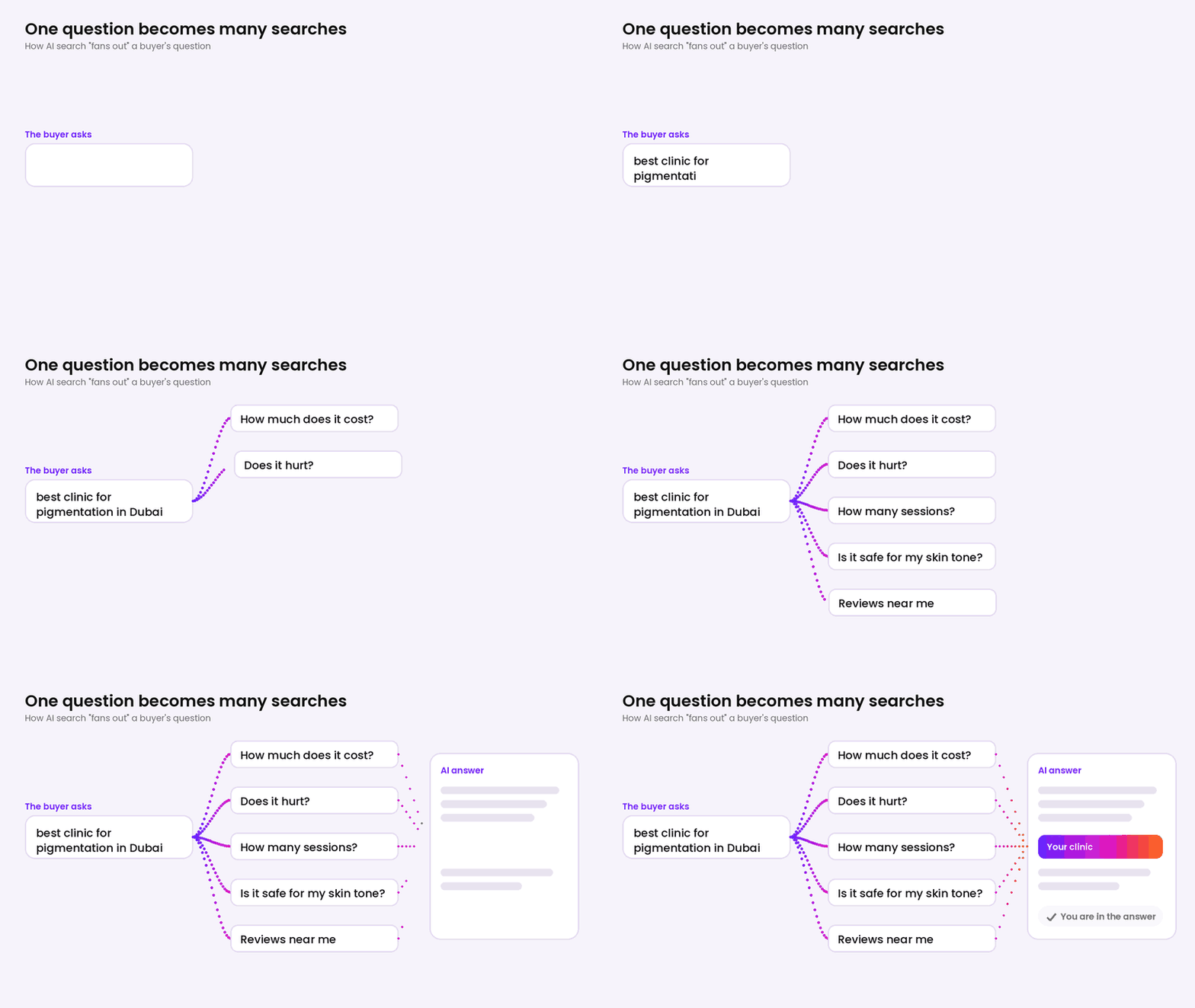
Google describes AI Overviews and AI Mode as using a "query fan-out" technique, "issuing multiple related searches across subtopics and data sources". In practice, one question from a buyer becomes many smaller searches behind the scenes. That favours pages that cover a topic fully, with clear sections for the sub-questions, over thin pages aimed at one keyword. It also means your competitor comparison, pricing context and "how it works" content can surface in answers to questions you never targeted directly. We map the likely sub-questions for each priority topic and make sure a page of yours answers each one.
Schema and FAQ markup
Structured data, often called schema, labels what a page is: a business, a product, an article, a question and answer. It helps machines read your page accurately. Google is clear that no special markup is needed for AI features, so we use schema for accuracy, not as a trick: organisation details, local business information, articles, and products, always matching the text a visitor can see. We validate it after every release, because broken markup is more common than missing markup. On FAQ markup specifically, check Google's current documentation before you invest, as the way search results display it has changed over the years; the value of writing a clear FAQ for people remains.
Content SEO
Content SEO is the writing that earns the questions: guides, comparisons, glossaries and case studies that answer what buyers ask, in the voice your market uses. In 2027 the test is "is this the best answer on the internet for this question?" Forrester's October 2026 prediction that human-generated content will become a top priority again for 50% of brands points the same way: first-hand experience, real examples and original data are what machines and people both trust. We write with named sources, current figures and examples from the region.
Link building
Link building is earning mentions and links from credible websites, so that search engines and AI tools see you described by others, not only by yourself. Google says prominence for local results also reflects how many sites link to your business. The durable way to earn them is to publish something worth citing: original research, a clear explainer, a useful tool. We pursue relevant, editorial links, such as industry publications, partners, associations and local media, and we do not buy links or use schemes that search engines treat as spam.
Competitor, audience and consumer intelligence
This is the research that tells you who matters, how they decide and what rivals leave open. The need is real: Brandwatch's March 2026 report, based on 1,028 marketing professionals and 750,000 online conversations, found that only 25% of marketers say they understand their audiences "very well", with 60% struggling to predict future needs and 40% to understand the "why" behind decisions.

Market and competitor research
Competitor research maps who you really compete with, which can differ from who you think. It covers positioning, pricing signals, offers, ad activity, website and search presence, and customer reviews. The market is getting more crowded, which raises the stakes: the Dubai Chamber of Commerce reported 37,373 new member companies in the first nine months of 2026, and Saudi Arabia's Ministry of Investment issued 9,018 investment licences in the second quarter of 2026, up 252% on a year earlier (16,645 in the first half). More entrants means more ads, more offers and more noise for the same buyer.
The same pressure shows up inside companies: Crayon's 2026 State of Competitive Intelligence, a vendor survey, says the majority of deals are now competitive and two-thirds of teams use a dedicated platform. We treat that as a signal of how seriously the practice is taken, and we deliver the output in plain language, not as a software export.
We deliver a one-page map per competitor group, a gap list (what nobody answers well) and a short list of moves to make or avoid.
Audience and consumer insights
Audience insight is knowing who your buyers are, what they care about and how they decide, beyond demographics. In the GCC the detail matters. BCG's 2026 Saudi consumer outlook, based on 1,895 consumers surveyed in April 2026, found that only 31% of purchases involve a brand chosen in advance, leaving roughly seven in ten open to influence, that 59% are willing to pay more when better quality justifies it, that 85% see a physical store as important or essential, and that 61% do not want brands accessing their data. Those four numbers change how you brief creative, set offers, plan retail and ask for consent.
[[chart:b2b]]
Our method blends sources: platform data, search demand, review mining, a short survey or interviews where the budget allows, and sales-team input. We turn them into three to five audience profiles, each with the question they ask first, what blocks them, which proof they trust and where they spend time. Where the evidence is thin we say so and recommend what to test.
Social listening
Social listening is reading what people say about your brand, category and rivals, and turning it into decisions. It is useful for early signals, not only crisis control. Sprout Social's June 2026 research, a survey of 2,250 social media users in the US, UK and Australia, found that 64% say it is important for brands to respond publicly on social, 84% say response speed directly affects their view of a crisis, and that 30% turn to social for product reviews. The sample is not GCC-specific; the behaviour it describes is global, and we validate it against local conversation.
We set up listening around brand terms, product names, competitor names and category questions, in English and Arabic, and review it weekly. The monthly output is short: the three themes that rose, the three questions people keep asking, one risk to watch and one opportunity to act on.
A simple scoreboard: share of search
One measure ties competitor and audience work together: share of search, your brand's share of all searches for brands in your category. The IPA's share of search report (last updated 23 October 2026) describes it as an early indicator of future movements in market share, sometimes up to a year ahead. WARC reports that Adidas uses organic search data as its main way to track brand health across 38 countries, instead of regular surveys, and says it saved 60% in tracking costs. For a smaller brand the version is simple: pick your five closest rivals, note how often each name is searched each month, and watch the share move after campaigns, launches and seasons. It costs nothing and gives finance a number they can trust.
Go-to-market
Go-to-market is the plan for reaching a defined customer with a clear offer, through chosen channels, in a sensible order. It applies to a new brand, a new product, a new city or a new country, and it is our second Signature service because it is where intelligence turns into a launch.
Go-to-market strategy
A go-to-market strategy answers six things: who the ideal customer is, what problem you solve for them, what the entry offer is, which two or three channels you will use first, what the week-by-week sequence looks like, and which numbers tell you it is working. Most plans fail in the second item, because "everyone who might need us" is not a customer.
New launches are risky, so evidence helps. NielsenIQ's April 2026 innovation report found that of more than 3,500 new brands and sub-brands launched in 2025 across the UK, Germany, France, Italy and Spain, only one third reached 1% of households, and only 17% combined strong trial with repeat purchase. It also found that 86% of innovation sales among successful launches came from shifting existing demand, with 14% truly incremental. That is European FMCG data, but the lesson travels: winning means taking share from someone, so you need to know whose.
More than 3,500 new brands and sub-brands launched in 2025 across five European markets. This is European consumer-goods data; the lesson, that launches need a specific customer and a plan, travels.
Source: NielsenIQ, Launch Fast, Learn Faster, 20 April 2026.
A public GCC example of a staged entry is Primark's arrival in the UAE. Alshaya Group announced on 26 March 2026 that Primark opened its first UAE store at The Dubai Mall, over 60,000 sq ft with 600 colleagues, and named the next openings: City Centre Mirdif in April 2026 and Mall of the Emirates in May 2026. We have no inside view of Primark's plan, so this is our reading of what is public: one flagship, then two more locations in quick succession, with a local partner. That is a sequence, not a single big bang, and it is a useful pattern for smaller brands too: prove the offer in one place, then widen.
Our output is a one-page plan plus a 30-60-90 day sequence, with the channels, the content needed for each, the budget split and the decision rules ("if cost per enquiry is above X after 14 days, we change Y").
Growth strategy
Growth strategy decides where the next 20% comes from: new customers, more from existing ones, new products, new markets, or better conversion. We size each option with the data you have, rank them by effort and likely return, and pick one or two. It prevents the common trap of trying all five at once and learning nothing from any.
McKinsey's 2026 Global B2B Pulse (nearly 4,000 decision-makers in 13 countries) shows what separates leaders: 60% of market leaders reported double-digit revenue growth in 2025 against 21% of laggards, and "inconsistent information across teams" is now the leading reason buyers switch suppliers. Growth strategy is partly about getting your own story consistent across sales, marketing and service.
Brand strategy and social listening
Brand strategy is deciding what you stand for, who you stand for and why anyone should choose you, then making sure every channel says the same thing. It sounds abstract until you attach it to money. Kantar's 2026 BrandZ ranking found that brands which improved their meaning and relevance to consumers grew their brand value by an average of 129% since 2019, against 80% growth for brands that lost meaning over the same period.
Brands that became more meaningful to people grew their value faster than brands that lost meaning, over the same period.
Source: Kantar BrandZ 2026, reported by Marketing Week.
Brand strategy
A brand strategy produces a short document everyone can use: the audience, the promise, the proof, the personality and what you will never say. We keep it to what a designer, a copywriter and a salesperson would all use on Monday morning. For premium and B2B brands it also includes the standards of evidence, such as which claims need a number and which need a client name.
Positioning and messaging
Positioning is the one sentence that tells a buyer what you are, for whom, and why you are different. Messaging is how that sentence is expressed across the website, ads, sales calls and social. The test is whether a stranger can repeat it after ten seconds. The Gartner May 2026 finding that 51% of buyers say they are more likely to meet misleading information from generative AI, against 49% for sales reps, is a reminder that buyers verify. Consistent, specific, provable messaging is what survives verification.
We write a message house: one headline claim, three proof pillars and the objections each audience raises, in English and, where relevant, Arabic written for the market and not translated word by word. YouGov's February 2026 Ramadan study (6,308 adults across five markets) found UAE respondents named local culture and special offers (both 27%) as the top things that make advertising feel authentic, followed by charitable action (25%), while in Saudi Arabia special offers led at 27% and local culture followed at 24%.
Seasonal and campaign planning
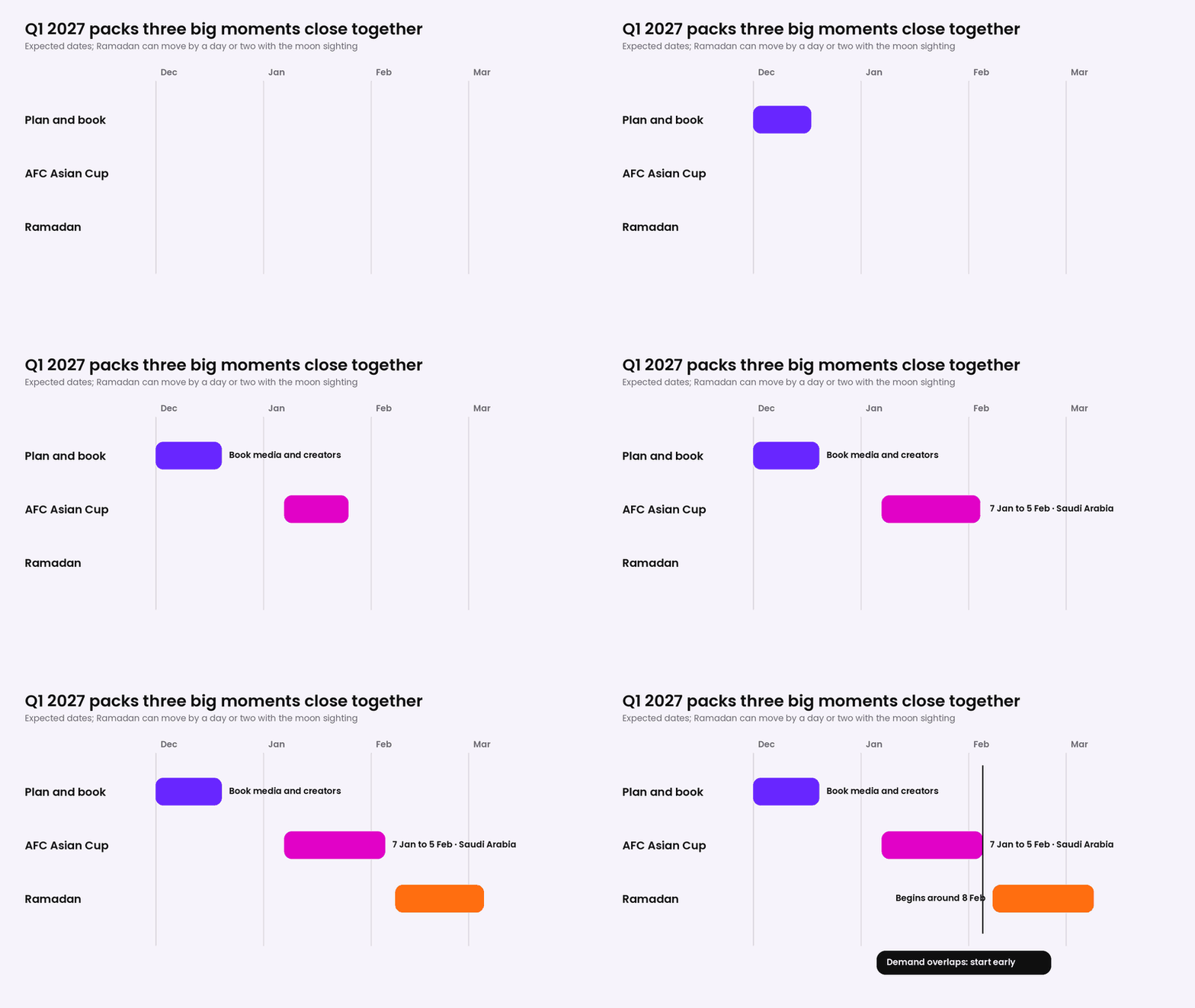
Seasonal planning decides when to spend, on what, for which audience, and how early to start. In the GCC the calendar is unusually powerful, and it is moving. Ramadan shifts about 11 days earlier each year; our MENA & GCC outlook expects it to begin around 8 February 2027, after the AFC Asian Cup in Saudi Arabia in January.
Behaviour in peak periods is measurable. Google and Visa's research on UAE and Saudi peak moments, published in September 2025, found deal-related search interest up 69% in Black Friday week, with spending up 31% in the UAE and 36% in Saudi Arabia, and Saudi Founding Day spending 44% above non-peak times. And planning starts earlier than most budgets: Worldpanel by Numerator's analysis of Ramadan 2026, reported by Khaleej Times on 10 November 2026, describes consumers as "becoming more intentional, planning ahead", with UAE FMCG spending up 5.3% and volume up 3.5% in the quarter, while only 53% of categories grew in volume, down from 64% over the previous 12 months.
Read that last number carefully. A strong season lifts the total, but fewer categories share the lift, so being in the right category with the right message earlier is worth more than a large last-week push.
Our seasonal plan fits on one page: the key dates for your sector, the three audiences and what each needs at each stage, the offer calendar, the creative and content production deadlines worked back from launch, and the media windows. It also marks the dates where you should not compete, because the cost of attention is too high.
What does the work look like in practice?
The best way to see the difference is a worked example. This one is illustrative: a composite built to show the method, not a client result, and the figures in it are assumptions.
The situation. A skin clinic in Dubai has run Instagram ads for a year. Enquiries are steady but flat, and the owner wonders whether to spend more on ads, open a second branch or invest in the website.
Week 1: the baseline. We ask 30 buyer questions across Google, ChatGPT, Gemini and Perplexity, such as "best clinic for pigmentation in Dubai" or "is laser hair removal safe in summer". The clinic appears in Google's map results but in none of the AI answers for treatment questions. Two rivals appear repeatedly, and one is cited from a long, clear treatment guide.
Week 2: the competitors. The two rivals do not have better offers. They have clearer pages: treatment explained in plain language, before-and-after policy, price ranges, who each treatment suits, and a visible practitioner profile. Their reviews mention staff by name.
Week 3: the customers. Reading 100 reviews and enquiries shows that people rarely ask "how much". They ask "does it hurt", "how many sessions" and "is it safe for my skin tone". The clinic's current ads talk about offers, not those worries.
Week 4: the decision. The strategy page reads: win women aged 28 to 45 researching treatments in the three months before Ramadan and Eid; answer their first three worries on one page per treatment; collect reviews that mention treatment and practitioner; run two channels, search and Instagram, with WhatsApp as the single next step; report booked consultations, not clicks. The second branch waits until the first one's calendar is full.
Nothing in that plan needed new media spend to begin. It needed someone to ask the questions in the right order, and to write down the answer.
What do you get at the end?
A strategy and intelligence engagement should leave you with assets you can use without us:
- A baseline report: your search and AI visibility today, in English and Arabic, with the questions, the answers and the sources cited.
- A competitor and gap map: who you compete with, what each does well, and what nobody answers.
- Three to five audience profiles: the first question each asks, what blocks them, what proof they trust.
- A go-to-market or growth plan: one page, with a 30-60-90 day sequence and decision rules.
- A message house: headline claim, proof pillars and answers to objections.
- A seasonal calendar: key dates for your sector, with production deadlines worked back from launch.
- A monthly review template: the handful of numbers and questions that keep it alive.
Which mistakes cost the most?
Five mistakes show up again and again, in every sector.
- Starting with the channel. Choosing Instagram, TikTok or Google before knowing where your buyer looks first is how budgets get spent on the wrong audience.
- Treating "everyone" as the target. The NielsenIQ finding that most launch sales come from shifting existing demand is the reminder: you win by taking a specific customer from a specific alternative.
- Checking AI answers once. Answers change. A single screenshot is a story; a monthly log is evidence.
- Writing the strategy and never reading it again. If the plan is not on the table at the monthly review, it is not a plan.
- Keeping sales and marketing separate. McKinsey's finding that inconsistent information across teams is now the leading reason buyers switch suppliers is a reminder that buyers meet your whole company, not your campaign.
Quick reference: the terms in plain English
| Term | What it means | Why it matters |
|---|---|---|
| Query fan-out | One question becomes several smaller searches behind the scenes | Pages that cover a topic fully can surface for questions you never targeted |
| Share of search | Your brand's share of all brand searches in the category | An early, free indicator of where market share is heading |
| Ideal customer | The specific buyer you will win first | Stops budgets being spread across "everyone" |
| Message house | One claim, three proof points, answers to objections | Keeps sales, ads and website saying the same thing |
| Structured data | Labels on a page that say what it is | Helps machines read your page accurately |
| Baseline | Where you stand today, recorded | Without it, nobody can say whether anything improved |
How do you use this in the next 30 days?
You do not need a large budget to start. This is the order we would follow.
- Week 1: baseline. Write down your 30 most valuable customer questions. Ask each one on Google, ChatGPT, Gemini and Perplexity, in English and Arabic. Record whether you appear and what is said.
- Week 2: competitors. Pick the five brands that appear instead of you. Note their offer, proof, price signals and review volume.
- Week 3: customers. Read 100 recent reviews and enquiries. Highlight the words customers use for the problem, the alternatives they considered, and what nearly stopped them.
- Week 4: decide. Write one page: who we win first, what we say, which two channels, which dates, which one number we report.
If you want a second pair of eyes on any of these, the Signal Check is free: send one link and we send back three things we noticed.
What should you ask a strategy and intelligence partner?
Good questions separate real work from slideware.
- What will I have in 30 days that I can act on? Look for a dated plan, not a promise of "insights".
- Which sources do you use, and can I open them? Every number should be traceable. Ours are, and this guide shows how.
- What will you tell me not to do? A useful strategy removes options.
- How will we know it worked? One agreed number, a baseline and a review date.
- Who does the work? Ask who will actually be in your account each week.
- What happens after the plan? Strategy that stops at a document leaves the hardest part to you.
What is likely to change by the end of 2027?
These are forecasts and expectations, with their sources. We will update this guide as the data changes.
| Area | What forecasters say | What to do about it |
|---|---|---|
| AI in buying | Forrester expects AI agents to influence 75% of B2B purchase decisions in 2027 | Publish clear, consistent, verifiable facts: pricing context, process, proof |
| Generative search | WPP Media forecasts generative search rising from 1% to 20% of MENA search-and-intelligence ad revenue by 2031 | Audit AI answers monthly; build the third-party mentions they draw from |
| Content | Forrester expects human-generated content to be a top priority again for 50% of brands | Invest in first-hand examples, original data and named expertise |
| Buyer verification | Forrester expects two-thirds of providers to lose deals because buyers cannot verify claims | Keep claims, case studies and numbers consistent across every channel |
| Budgets | Gartner found budgets flat at 7.8% of revenue in 2026 | Decide before you spend; test small and scale what works |
| Calendar | Ramadan begins around 8 February 2027, after the AFC Asian Cup | Plan Q1 media and creator booking early |
Frequently asked questions
What is strategy and intelligence in marketing?
It is the research and planning done before media goes live: who the ideal customers are, what they search for and say, what rivals do, how to enter or grow in a market, and when demand peaks. It ends in a single plan with one agreed business number.
What is the difference between AEO and GEO?
AEO, answer engine optimisation, is structuring your content so that search features and assistants can lift a direct answer. GEO, generative engine optimisation, is getting your brand mentioned and described correctly inside generative AI answers. They overlap, and both depend on clear, consistent, credible content.
Do I need special schema markup to appear in Google's AI Overviews?
No. Google states there is no special schema.org structured data you need to add, and no additional technical requirements beyond being indexed and eligible to appear with a snippet. Structured data is still useful for accuracy when it matches the visible text.
How often should I check what AI assistants say about my brand?
Monthly is a sensible rhythm. Answers vary between runs, so repeat each question and look at patterns, not single outputs.
Is Google still the main place people search?
Yes. In BrightLocal's July 2026 study of US consumers, 52% started their most recent local search on Google Search and 8% started with AI, though 75% used more than one channel. AI is a growing second stop.
How long does a go-to-market plan take?
A focused plan for one product and market can usually be agreed in two to four weeks, depending on how much customer and sales data already exists. The plan should include a 30-60-90 day sequence and decision rules.
Is social listening useful for a small brand?
Yes, because it needs attention more than budget. Set up searches for your brand, your product names and your category questions, and review weekly. The aim is three themes, three questions and one risk each month.
When does Ramadan start in 2027?
Ramadan is expected to begin around 8 February 2027, though the exact date depends on moon sighting and can move by a day or two.
Can AdTact audit my AI visibility?
Yes. We run a structured set of buyer questions across ChatGPT, Gemini, Perplexity and Google's AI features in English and Arabic, and report whether you appear, what is said and who appears instead. Start with a free Signal Check.
Methodology and sources
Every figure in this guide comes from a page we opened and read in November 2026, and we name the survey, sample and date where the publisher gives them. Where a source is a vendor survey, sponsored content or a non-GCC sample, we say so in the text. Forecasts are labelled as forecasts. Where publishers disagree, we use the series we can name. Our own recommendations are labelled as ours.
Search and AI behaviour: BrightLocal Local Consumer Review Survey 2026 (11 February 2026, 1,002 US adults) · BrightLocal local search behaviour study (9 July 2026, 1,227 US consumers) · Pew Research Center (March 2025, 900 US adults) · Ahrefs (4 February 2026, 300,000 keywords) · Statcounter · Google Search Central: AI features · Google Business Profile Help · Conductor via eMarketer · WPP Media via Communicate Online (27 June 2026).
Buyers, budgets and growth: Gartner, March 2026 · Gartner, May 2026 · Gartner CMO Spend Survey 2026 · Forrester 2027 B2B predictions · Forrester Predictions 2027: content · McKinsey Global B2B Pulse 2026 · Crayon State of Competitive Intelligence 2026.
Consumers, brands and launches: Brandwatch via AAP (17 March 2026) · Sprout Social (18 June 2026) · BCG Saudi Arabia consumer outlook (October 2026) · Kantar BrandZ 2026 via Marketing Week · NielsenIQ, April 2026 · YouGov, February 2026.
Markets, events and seasons: Dubai Chamber via Khaleej Times · Saudi MISA licences via Sharikat Mubasher · Alshaya Group on Primark · Google and Visa peak moments research · Worldpanel by Numerator via Khaleej Times · AdTact MENA & GCC outlook.